Download Brochure
9 min read
2026-04-01


Share
Over the last three decades, Indian metropolises have experienced phenomenal economic and demographic expansion, but this growth has been rapid rather than cohesive. Navigating the modern city means routinely confronting severe traffic bottlenecks, utility inconsistencies, and a chronic lack of spatial planning. This is not merely an inconvenience; it reflects the growing strain on traditionally planned urban systems. Traditional urban living in India has become fundamentally fragmented. The accelerating shift toward integrated townships is not a superficial lifestyle trend or marketing pivot. It is a structural response and a necessary correction to the broken, disconnected systems governing how our cities currently function.
In many cities today, homes, workplaces, schools, healthcare, and recreation exist in disconnected pockets, increasing dependence on long commutes and external infrastructure. In a typical Indian city, housing is developed on a plot-by-plot basis by private entities, while supporting infrastructure—roads, water, and power—is reactively retrofitted by overburdened municipal authorities. Because there is no unified master planning connecting the residential asset to its external ecosystem, severe operational gaps emerge. A premium high-rise may feature imported marble lobbies, but the moment a resident steps outside, they face unpaved roads and gridlocked traffic. In a fragmented model, extreme inefficiency becomes the normal baseline of daily existence.
The true cost of this fragmentation extends far beyond municipal logistics; it aggressively taxes the daily quality of life and economic productivity of its residents. According to World Bank data on urban growth and infrastructure strain, poorly planned urban expansion leads to severe spatial inequalities and drastically reduces civic efficiency. For the urban family, fragmentation translates into compounding daily losses. It is measured in hours lost to gridlock just to reach a school or grocery store. It is the ambient stress of relying on private diesel generators. Over time, this impacts both quality of life and everyday efficiency.
In direct contrast to this organic chaos, integrated townships offer a deliberately planned alternative. These are large-scale, master-planned developments that function as well-planned communities designed for everyday convenience. Rather than relying on the city to provide a supportive ecosystem, the developer engineers the ecosystem from the ground up. An integrated township is a mixed-use environment where residential, commercial, educational, and recreational zones are seamlessly woven together under a unified master plan. By centralising control over both the built environment and the supporting infrastructure, integrated townships reduce daily friction and improve everyday living, offering an environment that operates with the precision of a singular, well-managed system.
The true value proposition of a township is its infrastructure. In traditional developments, infrastructure is an external dependency; in a township, it is an internal guarantee. Urban planning discussions increasingly highlight the role of decentralised and efficiently managed infrastructure systems in improving long-term civic reliability. Within a township, water management systems incorporate massive rainwater harvesting and tertiary treatment plants. Road hierarchies are designed specifically for projected population density. Townships succeed because they solve the most complex infrastructure problems internally.
When planning is cohesive, mobility and safety improve significantly. In a fragmented city, a child walking to a playground or a resident cycling to a convenience store requires navigating hostile, high-speed traffic zones. Townships resolve this through intelligent internal road networks that strictly segregate pedestrian pathways from vehicular arteries.
Because daily necessities—from healthcare to retail—are situated within a secure perimeter, external municipal dependency drops dramatically. Furthermore, safety shifts from being a reactive, individual burden to a proactive, structural feature. With controlled access points, daily life becomes more organised and convenient. Efficiency is engineered directly into the geography.
Perhaps the most visible casualty of fragmented urbanisation is environmental balance. Core city neighbourhoods have systematically sacrificed green cover for concrete density. According to NITI Aayog’s insights on urbanisation trends, maintaining adequate open spaces is critical for urban sustainability and public health. Yet, most Indian cities fall drastically short of global green space standards.
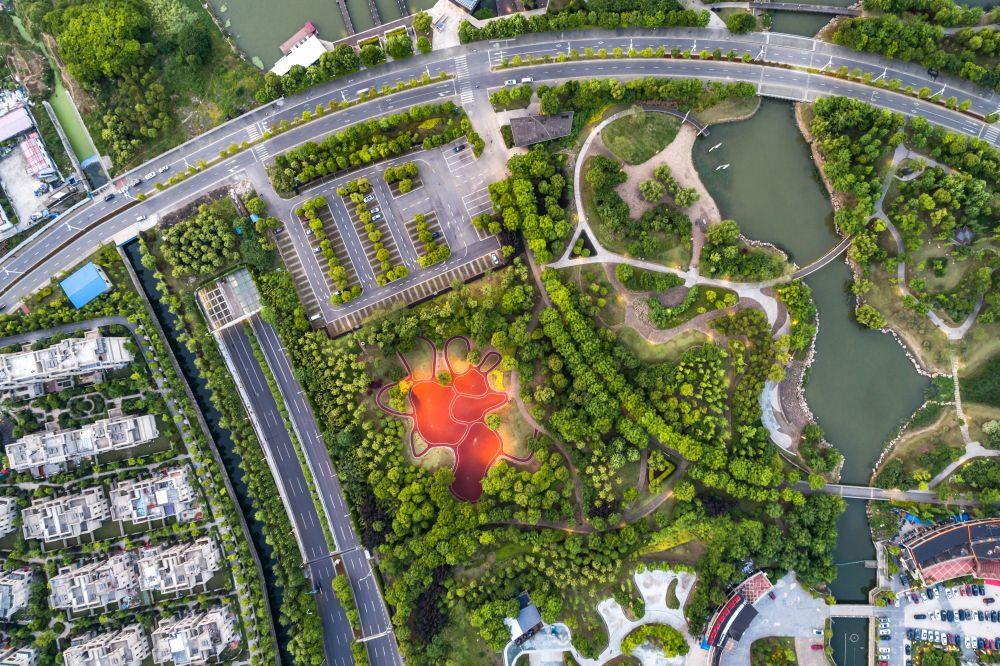
Integrated townships treat nature as critical infrastructure. Walkable green corridors, expansive central parks, and mature tree canopies are strategically placed to regulate microclimates, absorb vehicular emissions, and provide residents with psychological relief. Integrated townships create a more balanced living environment through planned open spaces, green zones, and organised infrastructure.
The growing preference for townships is driven by both lifestyle aspirations and long-term planning considerations. Many buyers today are prioritising planned communities that offer long-term livability, infrastructure reliability, and better lifestyle integration. JLL’s reports on township demand trends indicate a profound structural shift in capital allocation, with affluent demographics actively moving investments into integrated developments.
The economic rationale is better value retention. Because a township is a managed ecosystem, its roads do not degrade, and its security remains uncompromising. This sustained livability can support stronger long-term demand and value retention.
At the heart of this economic resilience is the role of long-term planning. Traditional city properties are entirely at the mercy of organic, unregulated neighbourhood growth. A premium standalone apartment can instantly lose its valuation if a noisy commercial complex is built next door. ANAROCK’s data on shifts in buyer preferences reveals that modern buyers heavily prioritise structured development over unpredictable organic growth.
In a township, zoning is absolute. Residential plots are permanently buffered from commercial nodes, ensuring population density never exceeds infrastructural capacity. This disciplined thinking provides buyers with absolute certainty about their neighbourhood for decades to come.
To maintain analytical objectivity, one must acknowledge the inherent trade-offs of the township model. Executing a development of this scale requires massive, contiguous land parcels, which are entirely unavailable in saturated city centres. Consequently, integrated townships are almost exclusively located on the urban periphery. This implies geographic distance from traditional central business districts.
Additionally, the initial cost perception can be challenging, as buyers pay a premium for broader civic infrastructure. However, for a rapidly growing demographic, commuting an extra few minutes via new expressways is a highly acceptable trade-off for reclaiming decades of infrastructural peace of mind.
The traditional model of piecemeal, fragmented urban growth has reached its absolute limit. It is no longer viable for either the municipal authorities trying to manage it or the citizens trying to live within it. Integrated townships are increasingly emerging as a preferred model for planned urban expansion. As infrastructural arteries—like peripheral ring roads and regional transit systems—continue to expand into suburban corridors, the physical distance between townships and the city core will mentally collapse. Large-scale integrated developments are expected to play a significant role in the future of urban growth.
The criteria for evaluating premium real estate have permanently changed. Homebuyers and investors have realised that a home cannot be evaluated in isolation from its immediate environment. The future of urban living will not be defined by a central postcode alone, but by how seamlessly that location functions as a cohesive system.
Integrated townships are the necessary evolution of the Indian city, transforming disjointed, stressful environments into predictable, supportive ecosystems. At Trident Parktown, our commitment to this model ensures that our residents never have to compromise with a fragmented reality; they invest in a meticulously engineered, fully functional future.
Blogs
A Township Inspired by the Seven Chakras: A Life in Balance
As cities expand and lifestyles accelerate, residential planning is being challenged to balance physical comfort, mental clarity, and social continuity within everyday living.
Trident Parktown: Where Nature, Nurture & Community Unite
A conscious departure from high-density urban living, Trident Parktown is shaped by a three-leaf philosophy that brings nature, nurture, and community together into a balanced way of life.
The Weight of a Promise: Trident Parktown is Now RERA Approved
In the world of real estate, a project begins long before the first brick is laid. It begins with a promise. For the discerning homebuyer, that promise is a complex tapestry woven from architectural vision, lifestyle aspirations, and—most importantly—trust.

PROJECTS
Site Office
Trident Parktown,
Village Nizampur & Azizullapur,
Sector 19A & 40, Panipat, Haryana 132104
Corporate Office
Trident Realty,
16th Floor, DLF Square, DLF Phase-II, Jacaranda Marg
Gurugram-122002, Haryana (India)
© TRIDENT PARKTOWN PVT LIMITED, 2026 All rights reserved
The Developer has availed a construction loan from IndusInd Bank Ltd. (‘IBL’), and has mortgaged project land admeasuring 59.77084 acres and any structures built thereon to such lender, where necessary No Objection Certificates (NOCs) shall be provided by IBL, as per requirement.
Carefully Crafted By

PROJECTS
MEDIA CENTER


Site Office
Trident Parktown, Village Nizampur & Azizullapur, Sector 19A & 40, Panipat, Haryana 132104

Corporate Office
Trident Realty, 16th Floor, DLF Square, DLF Phase-II, Jacaranda Marg Gurugram-122002, Haryana (India)
© TRIDENT PARKTOWN PVT LIMITED, 2026 All rights reserved
The Developer has availed a construction loan from IndusInd Bank Ltd. (‘IBL’), and has mortgaged project land admeasuring 59.77084 acres and any structures built thereon to such lender, where necessary No Objection Certificates (NOCs) shall be provided by IBL, as per requirement.
Carefully Crafted By